ESA rehearses Mars rover operations with eight-day desert test of Rosalind Franklin prototype
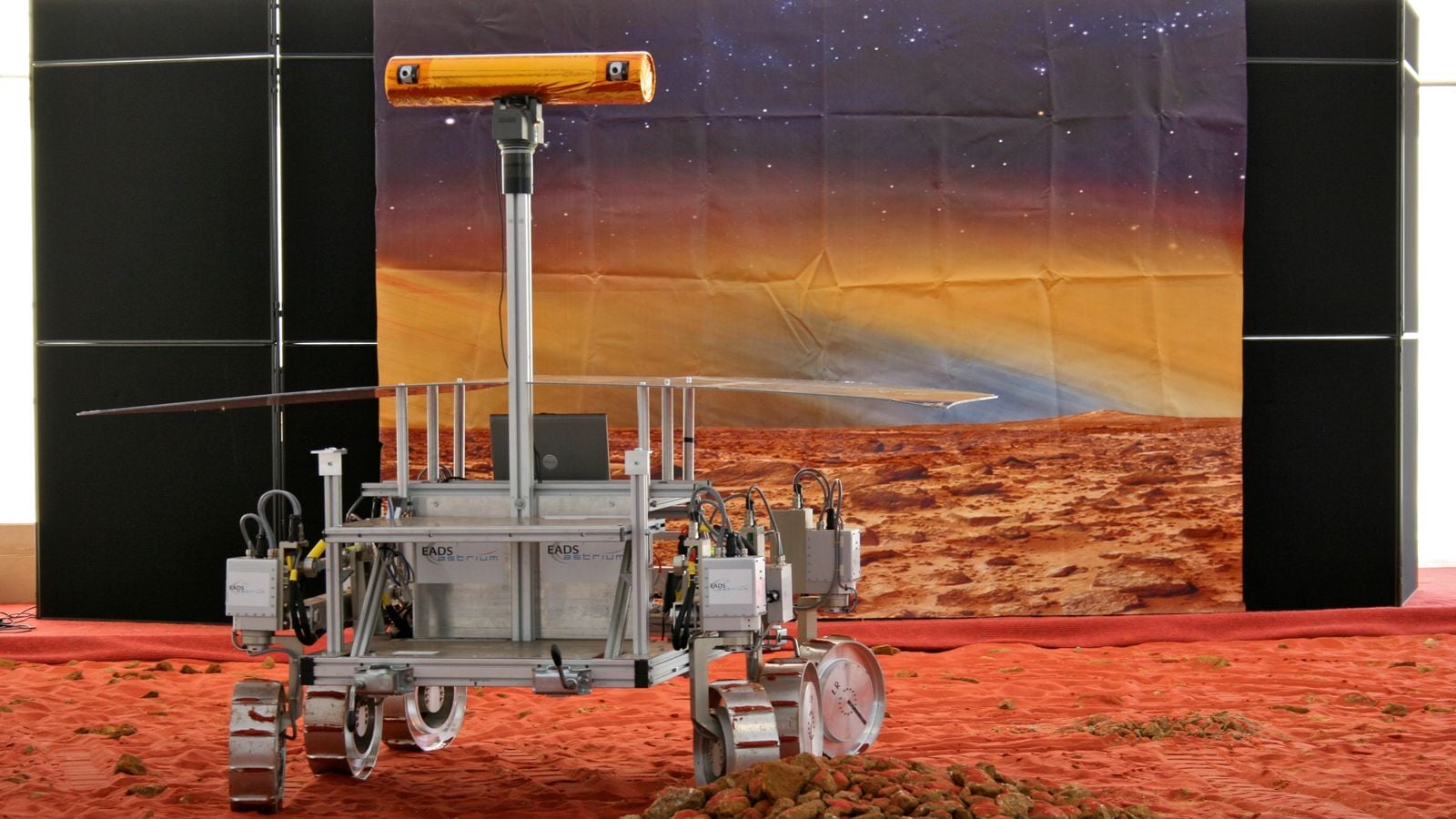
A prototype of the ExoMars rover called Charlie covered 220 metres in Spain's Tabernas desert while a science team in Turin sent its commands, ESA says.
Key points
- 1A Rosalind Franklin rover prototype named Charlie drove 220 metres over eight days in Spain's Tabernas desert, ESA says.
- 2About 100 scientists and engineers took part, with the science team commanding the rover from ROCC in Turin, about 1,200 kilometres away.
- 3On day six Charlie drove more than 60 metres on its own with a navigation error under 1%, according to rover operations lead Luc Joudrier.
- 4The next field test is planned for summer 2027 and will add challenges involving the ExoMars Trace Gas Orbiter.
- 5ESA expects Rosalind Franklin to land on Mars in 2030.
Full story
A prototype of the ExoMars Rosalind Franklin rover spent eight days in September driving a total of 220 metres across the Tabernas desert in south-eastern Spain, steered by a science team roughly 1,200 kilometres away, the European Space Agency (ESA) reports. The agency describes the exercise, which brought together about 100 scientists and engineers from around Europe, as a rehearsal for conditions the rover may meet once it reaches Mars in 2030. The prototype is called Charlie.
According to ESA, Tabernas was picked partly because its terrain resembles Mars. Planetary scientist Elliot Sefton-Nash said the local geology and mineralogy let the team set up a scenario realistic enough to put its science operations, interpretation and decision-making under pressure. Airbus built Charlie, and the prototype ran the guidance, navigation and control software that Rosalind Franklin itself will rely on to reach targets and avoid hazards.
Working from ALTEC's Rover Operations Control Centre (ROCC) in Turin, Italy, the science team used images, subsurface radar readings and spectral data sent by the rover to choose the most promising spots to look for evidence of life, which ESA names as the mission's main objective. The data came from prototypes of Rosalind Franklin's instruments: the PanCam cameras for distant and wide views, the CLUPI close-up camera, the Enfys spectrometer and the WISDOM ground-penetrating radar. ESA says these instruments are built to look for traces of ancient microbial activity.
Luc Joudrier, who leads rover operations for Rosalind Franklin, said “The rover worked like a charm.” He said the team also let Charlie explore by itself, and on day six it covered more than 60 metres with nobody driving and a navigation error below 1%. Not everything was simple. Chiara Lombardi, ExoMars rover and lander system engineer, said the steepness of one slope was hard to judge from the rover's data; the team first chose a cautious route, then used a digital elevation map to confirm the incline was gentle. Rain also interrupted the desert tests on one day, and Lombardi said the teams learned to change plans and priorities when something unexpected happened.
While the rover sent back its position, measurements and images, planners and scientists in Turin worked around the clock to get the next day ready, mirroring how the real mission is meant to run, according to ESA. ExoMars project scientist Jorge Vago said “We won’t have the luxury of time, so we must make each day on Mars count.” ESA describes the overall campaign as lasting 20 days, with daily data downlinks and checks of technologies and procedures in a demanding setting. Airbus UK organised the work in Spain, The Open University handled the control-centre side in Italy, and Thales Alenia Space leads the industrial team for the rover mission. The next field test, planned for summer 2027, is set to be more complex, with new challenges tied to the ExoMars Trace Gas Orbiter in Mars orbit.
Why it matters
Rosalind Franklin's main task is to search for evidence of life on Mars, and project scientist Jorge Vago says the team will not have the luxury of time once it is there. Field trials like this one let ESA and its industrial partners test the rover's self-driving software and the daily cycle of reading fresh data and choosing the next targets years before landing, on ground picked partly because it looks like Mars. Planetary scientist Elliot Sefton-Nash says the team learned a lot that will help it update its plans, and ESA says the 2027 test is meant to bring the rehearsal closer still to real operations.
Timeline
· Published
Topics#ESA#ExoMars#Rosalind Franklin#Mars#rovers#space exploration
Sources
This story draws on the following sources. Read them for full context.