Hubble image shows edge-on spiral galaxy NGC 1827 as part of satellite galaxy survey
NASA has published a Hubble Space Telescope view of NGC 1827, a spiral galaxy seen edge-on about 37 million light-years away, captured during a survey of low-mass satellite galaxies around Milky Way-like hosts.
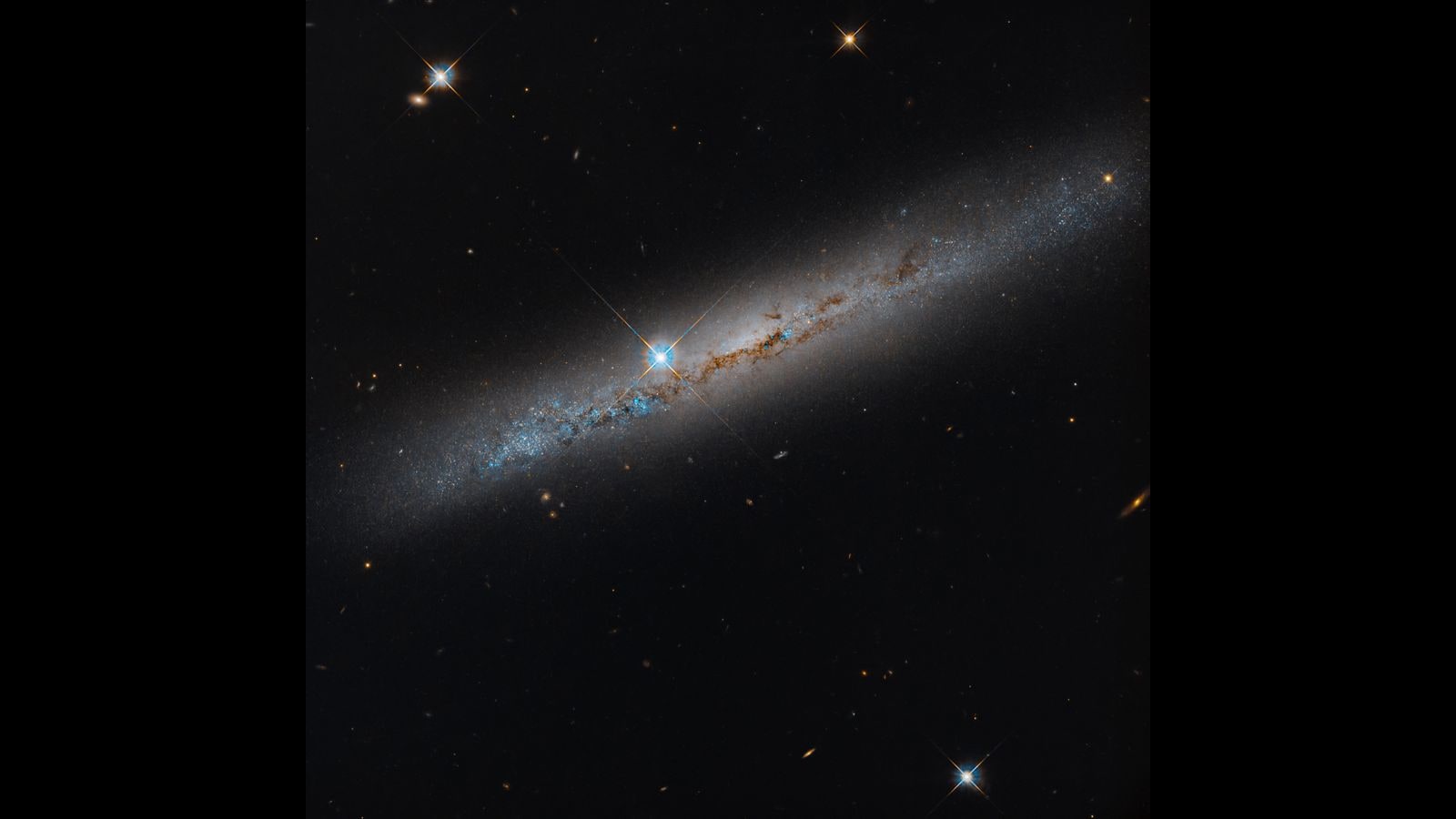
Key points
- 1NGC 1827 is an edge-on intermediate spiral galaxy about 37 million light-years away in the constellation Columba.
- 2The Hubble image, taken with the Advanced Camera for Surveys, shows dust lanes, blue star-forming regions and a foreground star with four diffraction spikes.
- 3The observation belongs to a survey of 260 satellite galaxies around 22 Milky Way-like hosts within about 32 million light-years.
- 4Hubble has observed 111 of the satellites; the rest need 149 more orbits, one per galaxy.
- 5NASA says low-mass galaxies help test cosmological models on small scales, where predictions struggle to match observations.
Full story
NASA released a new Hubble Space Telescope image on 16 October showing NGC 1827, an intermediate spiral galaxy viewed edge-on. According to NASA, the galaxy sits roughly 37 million light-years from Earth in the constellation Columba, the Dove. Seen from the side, its rusty-brown dust lanes cut across the disk along its full length.
The image was taken with Hubble's Advanced Camera for Surveys. NASA says it shows bright-blue regions along the disk, broken up by dark dust lanes, in which new stars are probably forming. Just left of the galaxy's central bulge sits a bright star, but it is a foreground object positioned between Earth and NGC 1827. Its four diffraction spikes come from light bending around the struts inside the telescope that support Hubble's secondary mirror. Other foreground stars in the frame can be recognized by the same spikes, while more distant galaxies dot the dark background.
The observation is part of a Hubble survey examining 260 satellite galaxies around 22 host galaxies similar to the Milky Way, all lying within roughly 32 million light-years of Earth. So far Hubble has observed 111 of these satellites. According to NASA, the remaining targets will require an additional 149 Hubble orbits, with one orbit allocated per galaxy.
NASA says low-mass galaxies like those in this observing program offer a way to test what cosmological models predict on small scales, where those models struggle to match observations. The agency expects the data to give researchers a better handle on the properties of low-mass galaxies around Milky Way-like hosts and, in turn, to refine cosmological models. The image is credited to NASA, ESA and Michael Jones of the California Institute of Technology, with image processing by Gladys Kober of NASA and the Catholic University of America.
Why it matters
Cosmological models have difficulty matching observations on small scales, such as those of low-mass galaxies. A systematic Hubble census of satellite galaxies around Milky Way-like hosts gives researchers a larger, consistent dataset to characterize these systems and refine the models, according to NASA.
Timeline
· Published
Topics#Hubble Space Telescope#NASA#NGC 1827#galaxies#cosmology#astronomy
Sources
This story draws on the following sources. Read them for full context.