Solar Orbiter traces a magnetic switchback in the solar wind back to its source on the Sun
Particles sampled inside a large switchback point to interchange reconnection at the solar surface, while waves and turbulence appear to shape it later, a study in Nature Astronomy reports.
Key points
- 1ESA’s Solar Orbiter flew through a large magnetic switchback and sampled its particles with the Solar Wind Analyser (SWA).
- 2The mix of charged oxygen and carbon particles points to an origin in hot magnetic loops at the Sun’s surface, according to ESA.
- 3The authors say this supports interchange reconnection as the formation process, with waves and turbulence taking over once the switchback moves out.
- 4A new model linked the measurements to NASA Solar Dynamics Observatory data to locate the switchback’s source region.
- 5The study, led by Jesse Coburn of CNRS/LPP, is published in Nature Astronomy.
Full story
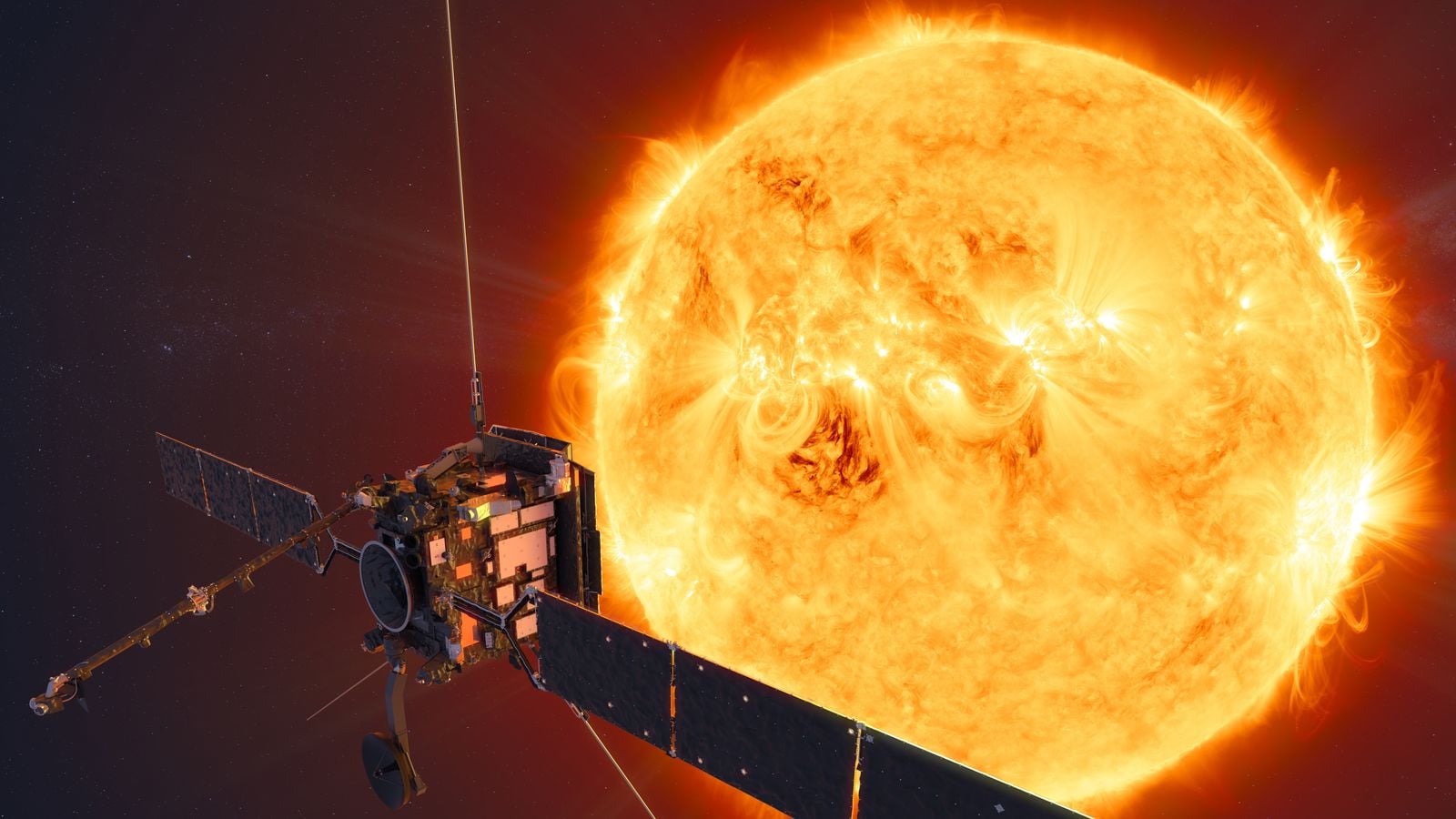
The European Space Agency says its Solar Orbiter spacecraft has followed a magnetic switchback, an S-shaped fold in the magnetic field carried by the solar wind, back to where it began on the Sun. The result comes from a paper led by Jesse Coburn of CNRS/LPP in France, titled “On the Coronal Origin of Magnetic Switchbacks in the Solar Wind” and now published in Nature Astronomy. According to ESA, the team identified the source by analysing the particles the spacecraft found inside the structure.
The solar wind is a constant outflow of hot, electrically charged gas, or plasma, that drags the Sun’s magnetic field out into the Solar System. Along the way, the field lines can twist, break or bend back on themselves. Switchbacks are one such feature: they have often been detected close to the Sun, but how they form is still debated. ESA recalls that in 2022 Solar Orbiter observed one from a distance and confirmed the S-shape that researchers had predicted but never seen directly.
This time the spacecraft passed straight through a switchback. “Solar Orbiter flew through a very large switchback,” Coburn says, explaining that this let the team measure rarely observed particles carrying clues to their origin. In measurements from the Solar Wind Analyser (SWA), taken while Solar Orbiter was about halfway between Earth and the Sun, the researchers found a combination of charged oxygen and carbon particles. ESA says this mix can only have formed inside hot magnetic loops at the solar surface.
Coburn describes two leading explanations for how switchbacks, and with them the solar wind, come about. The particle mix supports the first, interchange reconnection: open field lines, along which material can escape into space, meet closed loops that arc back to the Sun, and the lines break and reconnect so that plasma once trapped in a loop gets out. The competing explanation relies on waves and turbulence. Co-author Stephanie Yardley of Northumbria University, UK, says the team sees signs of those too, but likely only once the switchback has travelled away from the Sun. In her view both processes are involved and “they simply operate at different stages in a switchback’s lifetime”.
Besides the in situ particle data, the team examined images of the solar disc and modelled the magnetic fields of the Sun and the surrounding space. ESA says the researchers built a new model to work out where the plasma came from, linking Solar Orbiter’s measurements with data from NASA’s Solar Dynamics Observatory to locate the source region. According to ESA, the work also shows that the Sun’s atmosphere leaves its signature on solar wind particles, which could let scientists reconstruct the history of plasma measured far from the Sun.
Why it matters
The solar wind and its magnetic field drive space weather, and solar storms can damage satellites and other space-based technology. Daniel Müller, ESA Project Scientist for Solar Orbiter, says better knowledge of these dynamics helps protection: “The more we know, the better we can prepare for solar storms to protect our space-based infrastructure and technology.” The result also suggests that two rival explanations of switchback formation describe different stages of the same process, and that particles in the solar wind keep a record of where on the Sun they came from.
Timeline
· Published
Topics#Solar Orbiter#ESA#solar wind#space weather#heliophysics
Sources
This story draws on the following sources. Read them for full context.