Peking University study pushes dielectric-fluid chip cooling to 1,570 watts per square centimetre
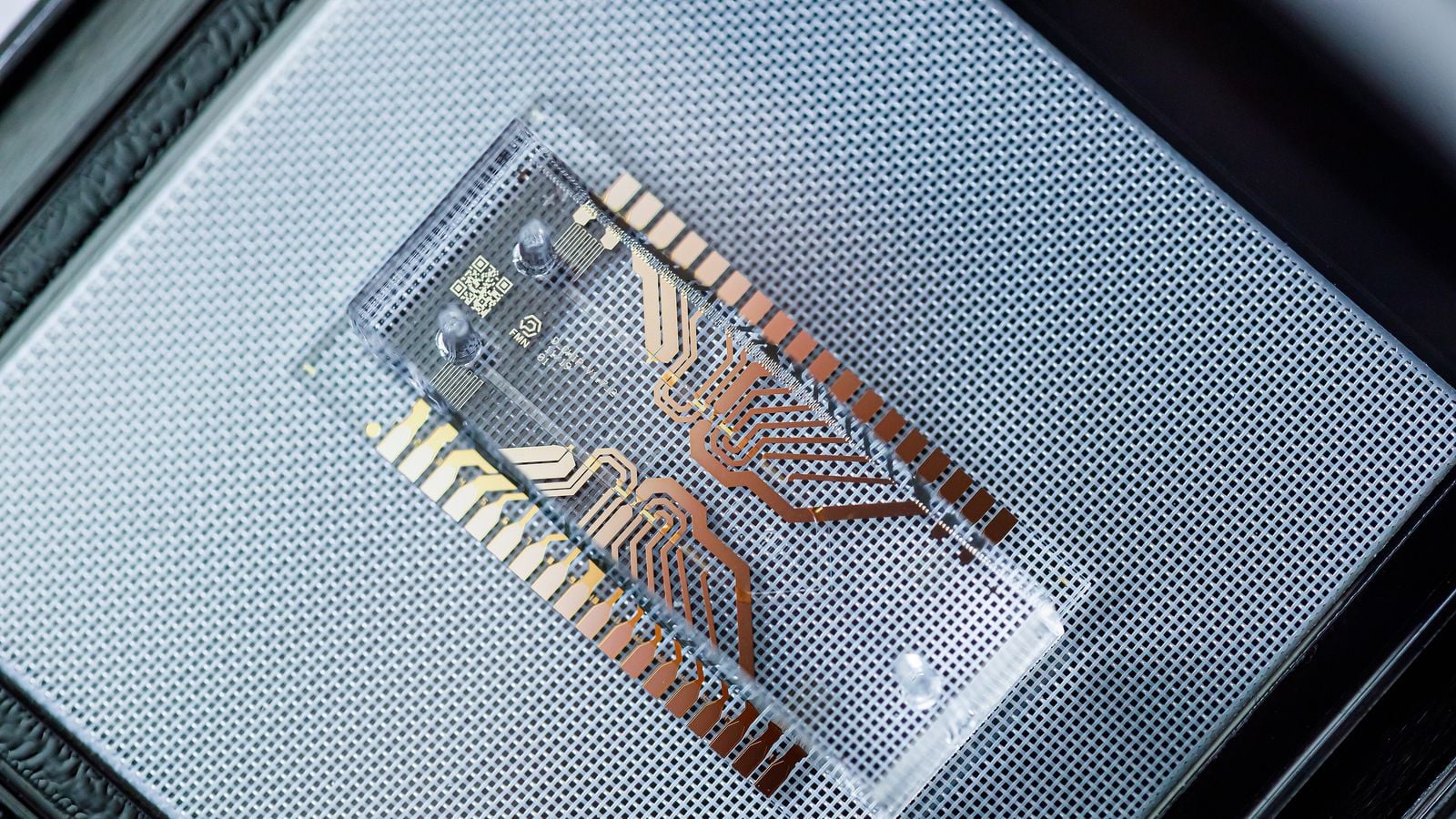
Channels etched into the chip let the non-conductive coolant HFE-7100 boil off far more heat than earlier dielectric designs, which often stayed below 1,000 W per square centimetre, the authors report in Nature Electronics.
Key points
- 1Peking University researchers report embedded chip cooling with the dielectric fluid HFE-7100 that reaches a critical heat flux of up to 1,570 W per square centimetre.
- 2Earlier techniques with dielectric coolants were often limited to below 1,000 W per square centimetre, even with pre-cooling and pre-pressurization, the authors write.
- 3A horizontal-up manifold feeds liquid in through horizontal inlets and lets vapour out through vertical outlets.
- 4The authors say the design, made with microelectromechanical systems technology, can be integrated with standard semiconductor processes.
- 5The paper was published in Nature Electronics on 7 October 2026; the full text is paywalled.
Full story
Researchers at Peking University have described an embedded chip cooling design that uses a dielectric coolant, a fluid that does not conduct electricity, and reaches a critical heat flux of up to 1,570 watts per square centimetre. The peer-reviewed paper appeared in Nature Electronics on 7 October 2026. The coolant is HFE-7100, and it carries heat away by turning into vapour, a method known as two-phase cooling.
The authors start from a familiar problem: chips keep getting smaller and more powerful, so getting heat out of them matters more and more. In embedded cooling, microfluidic channels are etched straight into the chip substrate, which brings the liquid close to the hottest spots. According to the paper, this approach can handle heat fluxes of up to 3,000 W per square centimetre when water is the coolant. Water absorbs and conducts heat well, but it also conducts electricity, so designers have to take care to avoid short circuits.
Dielectric coolants remove that electrical risk, but the authors write that earlier techniques using them have often been held below 1,000 W per square centimetre, even when the fluid was cooled and pressurized in advance. Their design reaches 1,570 W per square centimetre, according to the abstract.
The gain comes from what the team calls a horizontal-up manifold. Liquid enters through horizontal inlets, which helps fresh coolant flow back to the heated surface, and vapour leaves through vertical outlets so it is cleared faster. The device is made with microelectromechanical systems technology, and the authors say this means it can be built into standard semiconductor processes and scaled for future electronics. Figures listed in the paper compare the design with a structure labelled SPMC and with other representative two-phase cooling technologies, and also cover operational stability. The full article is behind a paywall; this report is based on the abstract and the publicly visible parts of the article page.
Wei Xiao and Zhihu Wu contributed equally to the work. Bai Song conceived the research and is the corresponding author, and he supervised it together with Wei Wang. The authors are listed under Peking University's School of Mechanics and Engineering Science, its School of Integrated Circuits and its National Key Laboratory of Advanced Micro and Nano Manufacture Technology. Funding came from sources including the National Natural Science Foundation of China, the National Key R&D Program of China and the Beijing Natural Science Foundation, and the authors declare no competing interests. The paper was received on 8 October 2025 and accepted on 11 September 2026. Its reference list includes a 2025 Nature Electronics paper by several of the same researchers on jet-enhanced manifold microchannels rated for heat fluxes of up to 3,000 W per square centimetre.
Why it matters
Water-cooled embedded designs can remove more heat, but because water conducts electricity, designers have to guard against short circuits. A coolant that does not conduct electricity avoids that risk, and this paper reports a dielectric design that clears the 1,000 W per square centimetre level earlier approaches often stayed below. Because it is made with microelectromechanical systems technology, the authors say it can be integrated with standard semiconductor processes. It is still a lab result: the publicly visible part of the paper does not report tests on commercial processors or in products.
Timeline
· Published
Topics#chip cooling#microfluidics#thermal management#semiconductors#Peking University#Nature Electronics
Sources
This story draws on the following sources. Read them for full context.