Webb finds the small host galaxy of the most distant fast radio burst seen so far
The James Webb Space Telescope located the faint galaxy behind FRB 20240304B and dated the burst to just 3 billion years after the Big Bang; its small, young host points the researchers towards magnetars as the source.
Key points
- 1Webb found the host galaxy of FRB 20240304B, which NASA, ESA and Keck Observatory describe as the most distant fast radio burst seen so far.
- 2Webb's NIRSpec measured a redshift of 2.148, which the releases equate to just 3 billion years after the Big Bang.
- 3The host is a small, star-forming dwarf galaxy about 1,000 times less massive than expected; ground-based telescopes, including Keck I, could not detect it.
- 4According to the researchers, the young host makes a neutron-star merger very unlikely as the origin and points to a young magnetar instead.
- 5The study, led by Manisha Caleb of the University of Sydney, was published in the journal Science on 8 October.
Full story
Astronomers using the James Webb Space Telescope, a joint NASA, ESA and CSA mission, have identified the galaxy that produced FRB 20240304B, which NASA, ESA and the W. M. Keck Observatory describe as the most distant fast radio burst found so far. The study, led by Manisha Caleb of the University of Sydney, was published on 8 October in the journal Science, according to the three press releases. Fast radio bursts, first discovered in 2007, are radio flashes lasting only milliseconds that reach Earth from far across the universe. Most are observed a single time and never seen again, and what causes them is still unknown.
The MeerTRAP team picked up the burst with the South African MeerKAT radio telescope on 4 March 2024, which is where its designation comes from. The radio data hinted at a very large distance, but confirming it meant finding the galaxy the burst came from. Although the position was known precisely, large ground-based telescopes saw nothing there. According to Keck Observatory, a team led by co-author J. Xavier Prochaska (University of California, Santa Cruz) spent one hour imaging the spot with the LRIS instrument on the Keck I telescope and found no galaxy. Prochaska said the team concluded that “if we wanted to find the source, we had to go to space”.
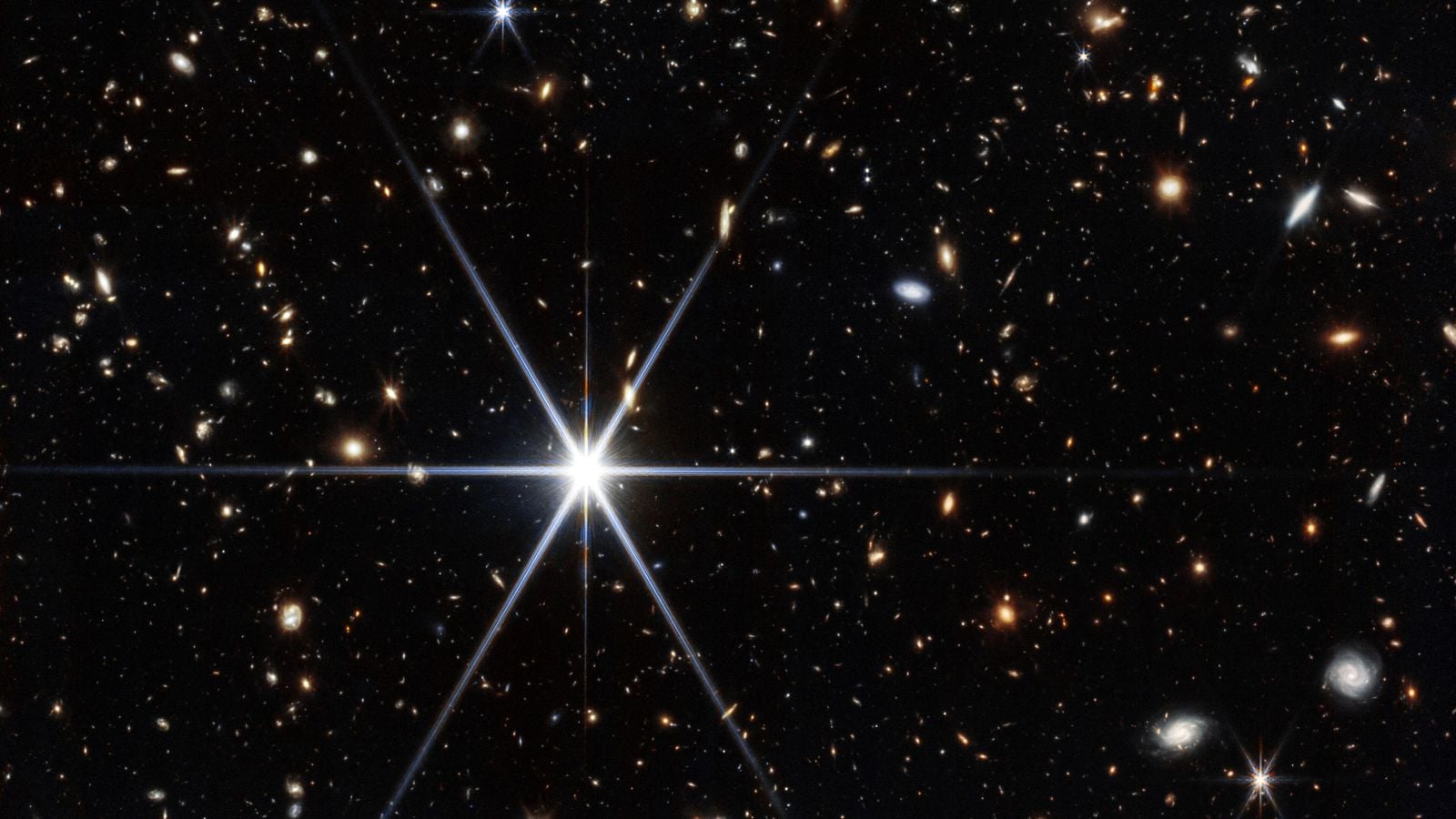
Webb's NIRCam camera then detected a galaxy at the burst's position, and its NIRSpec spectrograph measured the galaxy's redshift as 2.148, placing the burst just 3 billion years after the Big Bang. Keck says the measurement relied on light emitted by oxygen and nitrogen. Most fast radio bursts recorded so far happened billions of years later. The host also turned out to be unusual: galaxies linked to such bursts are typically massive and star-forming, whereas this one is a small dwarf galaxy about 1,000 times less massive than the team expected, though it is actively forming stars. It existed around cosmic noon, the era when star formation in the universe peaked, and its star-formation rate suggests that the bulk of its stars could have been born within only 30 million years. “The host sticks out in the whole galaxy sample that we have”, said co-author Ben Stappers of the University of Manchester.
The releases say this matters for the debate over how the bursts arise. One explanation holds that they come from two neutron stars merging. Because such pairs are expected to need billions of years to spiral together, bursts made this way should turn up mainly in older galaxies with evolved stellar populations. Another explanation points to a magnetar, a young and strongly magnetised neutron star left behind when a massive star ends as a supernova; it could emit bursts, for example through starquakes, without a long wait, which would place them in young galaxies like this one. ESA and Keck say the finding indicates that young magnetars are the likely cause. “Our work suggests that it’s very unlikely that this FRB was produced by a merger,” Caleb said.
The burst also served as a probe of the seemingly empty space between its galaxy and Earth. Prochaska compares a fast radio burst to a cosmic flashlight whose signal carries a record of everything it passes through, which lets astronomers trace the otherwise invisible matter of the cosmic web. In this signal the team found traces of two structures: a previously unknown galaxy cluster about 3.5 billion light-years from Earth, at a redshift of 0.3, and the nearby Virgo Cluster, about 54 million light-years away. Looking ahead, the researchers estimate that MeerKAT may detect and localise several bursts per year at redshifts above 1.0, which means more than halfway back to the start of the universe. They expect new radio facilities to raise that pace and Webb to be essential for studying the host galaxies of such distant bursts.
Why it matters
Fast radio bursts have been known since 2007, but their source is still debated, and most are seen only once. According to the researchers, a host galaxy this young fits the magnetar explanation better than neutron-star mergers, and the burst also shows that such signals can map matter between galaxies, here revealing a previously unknown galaxy cluster. The conclusion rests on a single burst, so it does not settle the question on its own. The team expects MeerKAT and newer radio facilities to localise more distant bursts, with Webb needed to study their faint hosts.
Timeline
· Published
Topics#fast radio bursts#James Webb Space Telescope#astronomy#magnetars#MeerKAT
Sources
This story draws on the following sources. Read them for full context.
- 1NASA · Primary sourceWebb Measures Distance to Farthest Fast Radio Burst, Suggesting Originscience.nasa.gov
- 2ESA/Webb · Primary sourceWebb measures distance to farthest fast radio burst, suggesting originesawebb.org
- 3W. M. Keck Observatory · Primary sourceAstronomers Pinpoint Host Galaxy of the Most Distant Fast Radio Burst to Datekeckobservatory.org